A key of network security is "know thy system". You cannot secure something that you do not understand or know how it works. In order to be proficient in network security, you have to understand the different types of networks since each network type poses different challenges, issues and risks. There are many types of networks which are used worldwide these days, both in houses and commercially we will discuss only seven which are most popular.
LAN - Local Area Networks
LAN connects network devices over a relatively short distance i.e. small offices, home, internet cafes etc. LAN uses TCP/IP network protocol for communication between computers. LAN is often but not always implemented as a single IP subnet. Since LAN is operated in short area so It can be control and administrate by single person or organization.
• In a "peer-to-peer" network, in which communication is carried out from one computer to another, without a central computer, and where each computer has the same role.
• In a "client/server" environment, in which a central computer provides network services to users.
 |
| LAN Sample |
WAN - Wide Area
Networks
As word 'Wide'
implies, WAN, wide area network cover large distance for communication between
computers. WAN is distributed collection of geographically LANs. A network
connecting device router connects LANs to WANs. WANs are an important piece of
enterprise networks. WAN used network protocols like ATM, X.25, and Frame Relay
for long distance connectivity.
• The most well-known
WAN is the Internet.
 |
| WAN Sample |
WLAN - Wireless Local Area Network
A
LAN based on WiFi wireless network technology Unlike LAN, in WLAN no
wires are used, but radio signals are the medium for communication. Wireless
network cards are required to be installed in the systems for accessing any
wireless network around. Mostly wireless cards connect to wireless routers for
communication among computers or accessing WAN, internet.
 |
| WLAN Sample |
MAN - Metropolitan Area Network
A
network spanning a physical area larger than a LAN but smaller than a WAN, such
as a city. This kind of network is not mostly used but it has its own
importance for some government bodies and organizations on larger scale. MAN,
metropolitan area network falls in middle of LAN and WAN, It covers large span
of physical area than LAN but smaller than WAN, such as a city
• A MAN is made from switches or routers
connected to one another with high-speed links (usually fibre optic cables).
 |
| MAN Sample |
CAN
- Campus Area Network
Networking spanning
with multiple LANs but smaller than a Metropolitan area network, MAN. This kind
of network mostly used in relatively large universities or local business
offices and buildings.
 |
| CAN Sample |
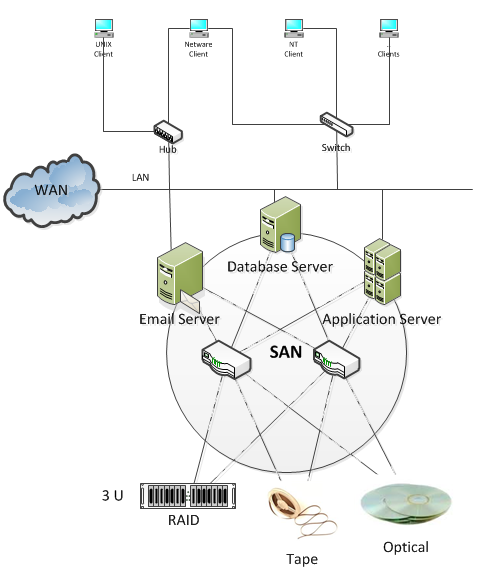
SAN - Storage Area Network
SAN
technology is used for data storage and it has no use for most of the
organization but data oriented organizations. Storage area network connects
servers to data storage devices by using Fiber channel technology.
.
 |
| SAN Sample |